Container Distributor: Make the Next Order Easier Than the First

We help commercial buyers choose the right flat-pack units, standardize specifications, plan delivery, and coordinate repeat orders so we can support one requirement today and a larger rollout tomorrow.

Finding a container distributor for a single order is one thing. Choosing one we can confidently return to when another project, facility, or customer needs units is more important.

Commercial requirements tend to grow.

We may start with one location and expand to several. Different teams may need different sizes. Accessories may change. Delivery destinations multiply. Procurement may need technical documentation. Operations may want the same configuration used again.

Without a clear purchasing standard, every new requirement can become another sourcing exercise.

We take a different approach.

Our flat-pack commercial units are built around standardized sizes and defined configurations, giving us a consistent product system we can plan, specify, purchase, and repeat.

Whether we need units for one site or a coordinated rollout across the United States, Canada, or Puerto Rico, we can build the requirement around what we need now while making future orders easier to manage.

Storage Units

Our core flat pack storage unit lineup is available in 7 sizes from 3.5′ to 19′. All units feature a 7.5′ width, galvanized steel construction, and a powder-coated finish for secure, standardized commercial storage.

3.5' x 7.5'

1m x 2.29m

Our most compact storage solution, perfect for tight spaces while providing superior protection and reliability.

Residential, Small spaces

5' x 7.5'

1.5m x 2.29m

Compact yet spacious container engineered for durability, versatility, and long-lasting performance.

Residential, Small business

7' x 7.5'

2m x 2.29m

Popular residential size offering excellent storage capacity with a manageable footprint.

Residential, HOA communities

10' x 7.5'

3m x 2.29m

Versatile mid-size unit that balances capacity with footprint. Perfect for contractors and job sites.

Contractors, Job sites

13' x 7.5'

4m x 2.29m

Extended capacity unit offering more space while maintaining easy transport. Great for equipment dealers.

Equipment dealers, Retail

16' x 7.5’.

5m x 2.29m

Large capacity storage for demanding applications. Ideal for industrial operations and property management.

Industrial, Property management

19' x 7.5’.

6m x 2.29m

Our largest single-compartment storage unit, providing maximum capacity for commercial and industrial needs.

Industrial, Large-scale storage

Flat pack commercial storage units from a consistent container supplier
Built for Repeat Purchasing Standard sizes.
Defined configurations.
Consistent ordering.

Establish the right product family once and use it as the starting point for future projects and locations.

Consistent Container Supply

Choose a Container Supplier We Can Keep Coming Back To

Availability can solve today's problem.

Consistency helps solve the next one.

When we expect to order again, we need confidence that dimensions, construction, locking, finishes, accessories, and configurations will not become a new decision every time.

Our storage-unit range includes 3.5', 5', 7', 10', 13', 16', and 19' lengths, all 7.5' wide . We also offer multi-compartment units, kiosks, office units, and accessories for requirements that extend beyond standard commercial storage.

Standardized product families give us a clear starting point.

Once we establish that a particular size and configuration works for an application, we can use it as the basis for the next project or location rather than sourcing an unrelated solution.

That makes repeat purchasing more predictable for procurement and more consistent for the people using the units.

Seven core storage lengths
Consistent 7.5' width
Multi-compartment units
Kiosks and office units
Repeatable configurations
Commercial accessories
Explore Container Sizes & Configurations
Specify Before You Scale

Get the Specification Right Before We Order More

Buying more of the wrong configuration does not create efficiency.

Before we establish quantities, we need to understand the application.

What are we storing? How much capacity do we need? How often will people access the unit? What footprint is available? Do we need shelving? Will the same configuration be used elsewhere? Would a multi-compartment, kiosk, or office configuration better match part of the requirement?

Our storage units use galvanized steel construction, powder-coated finishes, secure locking, and forklift pockets. Standardized dimensions and available accessories help us build specifications around recurring commercial applications.

The objective is not to add options for the sake of choice.

We want to identify the configuration that fits the work and make that configuration easier to specify again.

For larger organizations, that can mean establishing several approved standards rather than allowing every site to purchase independently.

One configuration might support tools and field equipment. Another might handle maintenance inventory. A different unit could support a larger storage requirement.

Once those standards are established, ordering becomes much clearer.

Request the Specifier Package
Build the Specification Around
01
Stored Materials

Define what needs to go inside the unit.

02
Required Capacity

Choose the amount of space the application actually needs.

03
Access & Footprint

Plan around frequency of use and available site space.

04
Shelving & Accessories

Configure the interior around everyday use.

05
Unit Type

Consider standard, multi-compartment, kiosk, or office configurations.

06
Repeatability

Decide whether the same configuration should become an approved standard.

Core Unit Details
Galvanized steel
Powder-coated finish
Secure locking
Forklift pockets

Plan Delivery as Part of the Order

A well-specified unit only helps when it can reach the location where we need it. Delivery should therefore be considered while we are planning the order—not after product selection is complete.

We support commercial requirements across the United States, Canada, and Puerto Rico, and we can plan around product type, quantity, destination, timing, and site requirements.

Our flat-pack format is an important part of that process. The products are designed around a flat-pack commercial system, allowing transportation and deployment to be considered as part of the overall requirement.

For one location, delivery planning may be straightforward.

For multiple sites, it becomes increasingly important to know which units are going where, when each location needs them, and whether site access or placement conditions need to be considered.

Clear delivery planning gives procurement and operations teams fewer surprises between approval and deployment.

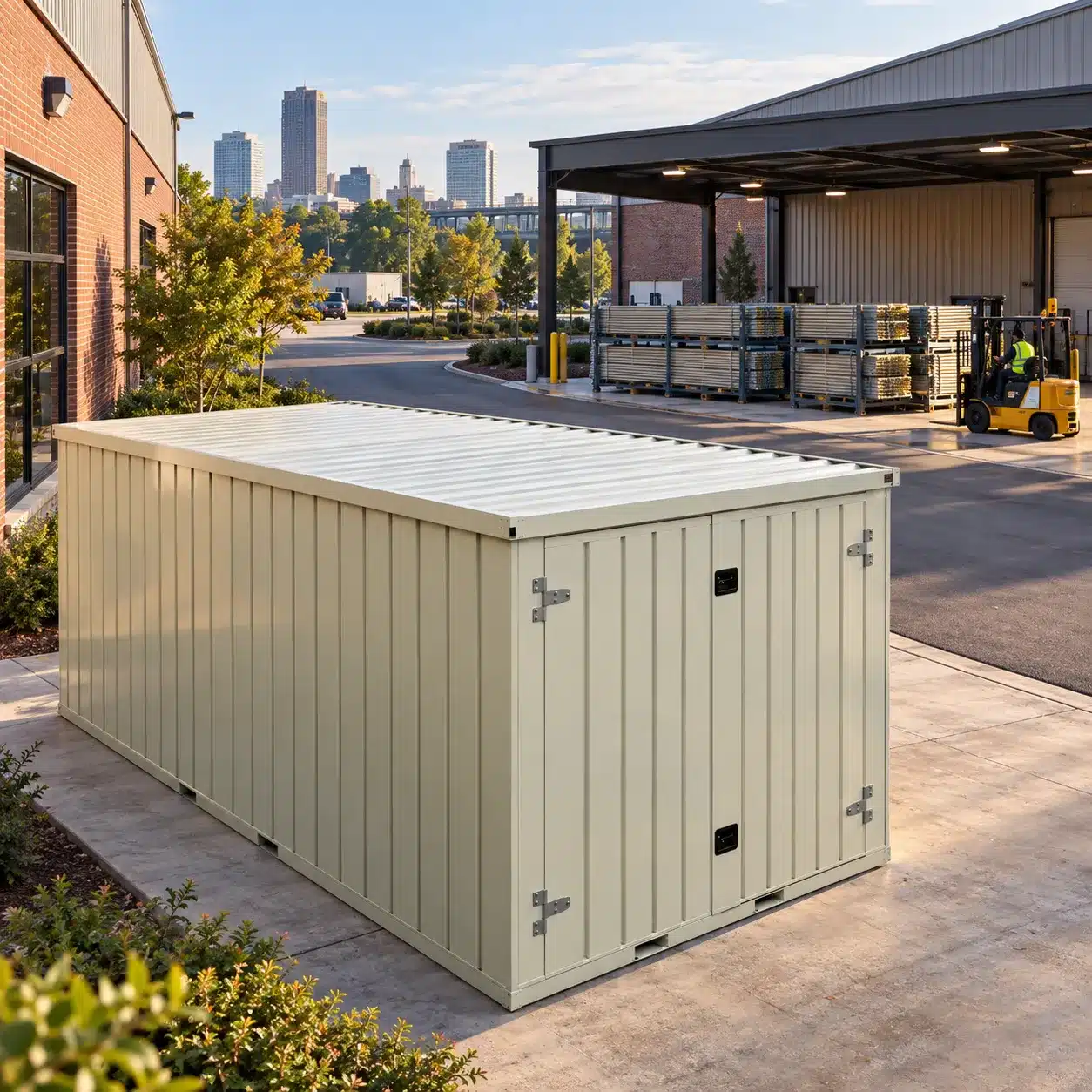
Flat pack storage container at a commercial facility in Richmond, Virginia
Define the Requirement First

Understand the Complete Requirement Before Comparing Price

Price matters, but the price of one unit rarely tells us the full story.

A commercial order can involve different sizes, quantities, accessories, destinations, delivery requirements, and timelines. Multi-site purchasing adds another layer.

That means we get a more useful picture when we define the requirement before reducing the decision to unit price.

We can establish:

what we need, how many units we need, which configurations apply, what accessories are required, where the units are going, and whether additional locations will need the same setup.

That gives us a clearer basis for purchasing and pricing.

It can also reveal opportunities to simplify the order. If several locations share the same requirement, we can standardize those units instead of treating every destination as a separate product-selection exercise.

For buyers comparing a container supplier or multiple container wholesalers , that distinction matters.

The better purchasing decision is not necessarily the quote with the simplest headline number.

It is the solution that fits the complete requirement.

Build Your Rollout BOM
Build the Full Buying Picture
01
Storage Need

Define what the operation actually needs to store.

02
Unit Quantity

Establish how many units the requirement calls for.

03
Configurations

Match sizes and unit types to each application.

04
Accessories

Include shelving, locking, and other required options.

05
Destinations

Account for each site, delivery point, and deployment requirement.

06
Future Locations

Identify where the same configuration may be needed again.

A complete requirement gives us a stronger basis for comparing pricing than a single headline unit price.

A supplier relationship should become easier to use over time.

If a 10' storage configuration works well for a recurring application, we should be able to build around that knowledge.

If a particular shelving arrangement works for maintenance inventory, we can make it part of the standard.

If another size fits a common site footprint, we can document that requirement for future locations.

The conversation changes from:
Before “What should we buy?”
After “How many of our standard configuration do we need?”

That is where repeatability starts creating value.

We spend less time revisiting basic product decisions and more time planning quantities, destinations, and timing.

Procurement A clearer purchasing process.
Operations Greater consistency between sites.
Facilities Teams Future requirements become easier to anticipate.

A dependable container distributor should become more useful as our needs grow.

Managing one requirement and managing a rollout are different jobs.

When multiple facilities or projects are involved, small differences can quickly multiply.

One location chooses a different size. Another changes accessories. Specifications drift. Teams source independently. Reordering becomes harder because no single standard exists.

We can simplify that process by creating repeatable configurations around common uses.

The quantities can change.
The destinations can change.
Individual site conditions can still require adjustments.
The core product specification does not need to be reinvented every time the address changes.

This approach can work particularly well for contractors, industrial and 3PL operations, property portfolios, utilities, franchise operations, municipalities, education systems, equipment dealers, and other organizations managing recurring requirements.

We support commercial deployments across the United States, Canada, and Puerto Rico, allowing us to plan standardized requirements while accounting for the practical differences between locations.

Request Multi-Site Pricing

As requirements grow, clarity becomes more valuable.

01

We want procurement to know what is approved.

02

We want operations to know what to expect.

03

We want facilities teams to know which configuration fits a recurring need.

04

And we want future orders to begin with an established specification rather than a blank sheet.

Our standardized flat-pack product range gives us that foundation.

We can define sizes and configurations, identify accessories, document technical requirements, plan delivery, and coordinate quantities around one location or several.

That creates a more useful relationship with our container supplier because we are not simply asking what happens to be available each time another requirement appears.

We are building around a product standard we already understand.

The first order establishes what works.
The next order should be easier.

Build Your Rollout BOM

Make the Next Order Easier

Choosing a container distributor should give us confidence beyond the first purchase.

We should know which products fit our application, which specifications we want to repeat, how delivery will work, and what happens when another project or location needs the same solution. We can start with one requirement.

We can establish the right sizes and configurations.

We can account for accessories, technical requirements, destinations, and timing.

Then, when the requirement repeats, we have a standard to build from.

That is how we make purchasing easier to scale from one unit to multiple sites without turning every new order into another sourcing project.

Flat Pack Containers for Commercial and Operational Use
Choose the Right Purchasing Path

Buying Units or Interested in Reselling Them?

Not every container distributor search represents the same buying need.

Purchasing Units

Buying for Your Own Operation

When we are purchasing units for our own facilities, projects, operations, or customers, we can begin by defining the product mix, quantities, accessories, destinations, and rollout requirements.

Build Your Rollout BOM
Dealer Opportunity

Stock and Resell Flat-Pack Products

When we want to stock and resell our flat-pack products, we can follow a dedicated dealer path built around that relationship.

Become a Dealer

Keeping those paths separate helps us move directly toward the information and purchasing process that fits what we are trying to accomplish.